
Leading Legal Innovation: Hilary Goodier on GenAI and Collaboration
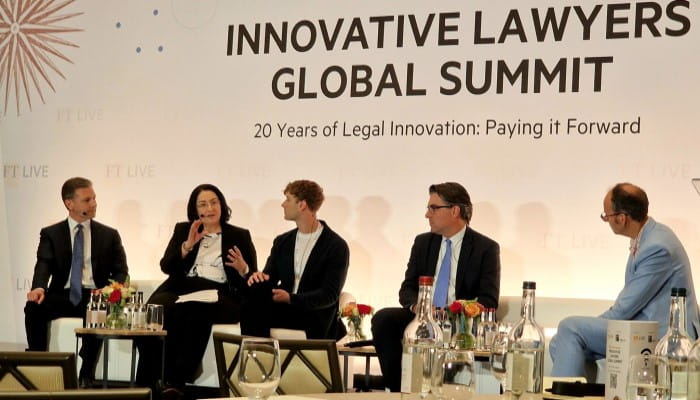
Hilary Goodier, Partner and Global Head of Ashurst Advance, took part in this year’s FT Innovative Lawyers Global Summit, where Ashurst was proud to be a gold sponsor.

Hilary joined the panel discussion 'The Human in the Loop' alongside Winston Weinberg, CEO and Co-Founder of legal AI company Harvey; Danny Tobey, Partner and Chair of AI and Analytics at DLA Piper; and Daniel Katz, Professor of Law at Chicago-Kent College of Law. In this interview, Hilary discusses the evolving landscape of the legal profession in a world shaped by generative AI, offering her perspectives on collaboration, industry transformation and the opportunities and challenges that artificial intelligence brings.
Fostering openness and collaboration in legal innovation - You highlighted the panellists' and participants' unique openness and willingness to share ideas at the FT Innovative Lawyers Global Summit. Why do you think this spirit of collaboration is so important for the legal industry as it navigates the GenAI era? And how can firms encourage this mindset of collective problem-solving?
Collaboration and transparency are crucial. The rapid pace of change, particularly with the advent of Agentic AI, means we are all learning while the tech is evolving. No single firm has all the answers, or the capacity to address every issue in isolation. By sharing ideas and experiences, firms can collectively solve problems, accelerate learning, and establish best practice that benefits the entire legal industry. A collaborative approach will also help ensure that the adoption of AI is safe, ethical, and creates lasting value for all stakeholders, not just individual firms.
Industry events like the FT Innovative Lawyers Global Summit create spaces for open dialogue. They demonstrate that, although competitive advantage is important, the broader goal is to move the industry forward and serve our clients to the best of our human and tech-enabled capabilities. Leaders need to show they are open to sharing their own experiences and should encourage teams to engage with their peers across the sector.
Balancing competitive advantage with industry progress - In your LinkedIn post, you mentioned the tension between maintaining a competitive edge and the need for the industry to move forward together, especially when it comes to adopting GenAI. How do you personally find that balance, and what advice would you give to other leaders facing this dilemma?
It's a nuanced challenge. Personally, I'm willing to share insights and experiences, even with competitors, when it serves the greater good of the profession. My advice to other leaders would be to recognise that the disruption is not just technological: it's also about business models and industry structures. Law firms differentiate themselves through relationships, innovation and client service.
Crucially, we're engaging with our clients on this topic: sharing knowledge, co-designing use case experiments, and jointly benefiting from efficiency gains. Following the recent FT Innovative Lawyers Global Summit, Ashurst, the FT and RSGI co-hosted a roundtable discussion for 20 General Counsel at our London office on 'The Future of Legal Leadership in the Age of AI'. The discussion explored how CEOs and Boards are reframing their expectations of the legal function, what this means for the evolving role of GCs and, importantly, how GCs can support and lead this change.
The roundtable sounds fascinating. Can you tell us a bit more about the themes emerging from the discussion?
There was full agreement that AI currently provides a significant opportunity to enable lawyers "doing legal work", but front of mind for General Counsel was how legal leadership in the coming age of AI looks very different from today. CEOs and Boards are reframing their expectations of in-house lawyers. This is an opportunity for General Counsel and legal leaders to go back to first principles, reimagine the purpose of the legal function, and for them to "advise and lead" the organisation through the change. By doing this, they can increase their influence and reposition themselves within the organisation to build stronger, more agile businesses.
Looking outwards, General Counsel are also keen to use AI to drive a step change in their relationships with external legal providers. The clear expectation is that law firms will use AI to deliver greater value and efficiencies for their clients, but in-house teams are also looking for opportunities to come together around AI experimentation… by co-designing legal offerings and workflows. It's fair to say there is a clear appetite for moving towards more "transformative partnerships".
Creating lasting value with GenAI - Drawing on your experience at the intersection of law and technology, what are the most significant opportunities and risks for law firms seeking to create lasting value for clients and stakeholders through GenAI? How can firms ensure that their adoption of AI is both safe and sustainable?
AI is fundamentally changing how legal work is conceived and performed. It enhances efficiency and can enable lawyers to operate at a higher strategic level, which is the most significant opportunity. And it's doing so in a way that creates value for both the firm and its clients. However, the risks include potential ethical pitfalls, and robust governance is required. Ensuring that AI augments and enhances (rather than replaces) human expertise is the challenge.
To ensure AI's safe and sustainable adoption, firms must invest in AI literacy, establish clear governance frameworks, and focus on a human-centred, experience-led approach. This means understanding where AI can add the most value – and more importantly where it can’t – and then training lawyers to work effectively with AI. Its success will depend on shifting mindsets, cultural change and the agility of businesses, as much as technological investment.
And data is key: at our recent roundtable, Winston Weinberg, CEO and Co-Founder of Harvey, shared valuable insights on how GCs can prepare their teams for the opportunities and challenges of GenAI. Winston’s top tip was: “Get your legal team's data organised.”
Personal reflections and next steps - As a speaker at the summit, what was your most memorable moment or key takeaway? How will you apply the insights you've gained from panel discussions or informal conversations to your work at Ashurst and in terms of the wider legal community?
The collective willingness of panellists and participants to openly share their ideas and to approach the challenges of GenAI as a shared opportunity is what sticks with me – the importance of collaboration and the need for the legal industry to do better in moving forward together.
Within the next 6 to 12 months, firms will have to rethink service delivery, redefine roles, reassess business models and invest in AI literacy. Our goal is to help shape the profession’s response to GenAI, including ensuring that the transition is both innovative and responsible, and to be part of building a more collaborative and forward-thinking legal community. At Ashurst we're already doing this. Ashurst Advance is envisaging generative AI at the heart of its core services and is working closely with clients to understand the capabilities and the limits of generative AI, as well as the outcomes it delivers.
