The three key trends emerging in public M&A in 2025


Ahead of the Deal - Australian M&A Briefing
Following on from the launch of our M&A Deal Report 2025, a look at schemes and takeovers with a deal value of more than $50 million in the 8 months to 31 August 2025 shows healthy activity levels, but more interestingly, three trends that are shaping deal-making this year.
Private capital had a slow start in 2025 for public to private transactions, with only 4 public M&A deals announced in the first half of the year involving private capital bidders. However, private capital has come out swinging in the second half, with 6 public M&A deals involving private capital acquirers announced in July and August alone. This has pushed the proportion of public M&A deals instigated by private capital bidders up to 33% of total deals for the year-to-date, broadly in line with 2024 and 2022 (and ahead of 2023).
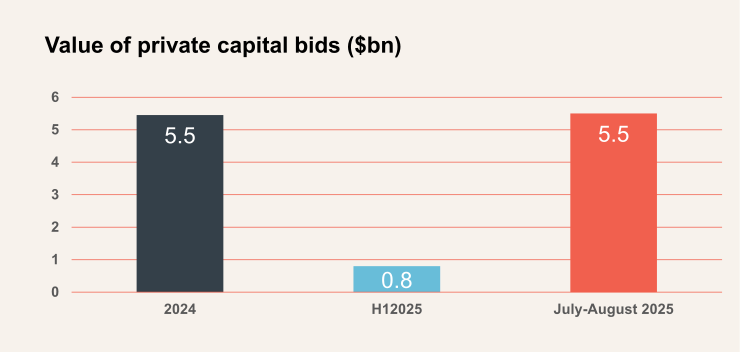
When it comes to public M&A deals involving private capital, the difference between the somewhat sluggish first half of the year and red-hot start to the second half of 2025 is even more pronounced when we examine deals by value. The aggregate transaction value of private capital bids for the year to date was nearly $6.4 billion – of which over $5.5 billion is attributable to public M&A deals announced in July and August. Indeed, the value of private capital bids announced in the last two months is equivalent to the total value of all public to private capital deals announced in 2024.
Ashurst has been involved in all 3 of the largest deals involving private capital bidders in 2025 – all of which have been announced since 1 July 2025. This includes advising:
Schemes of arrangement continue to be the predominant deal structure in 2025. This is particularly the case at the upper end of the market, representing more than 90% of the aggregate public M&A deal value of transactions announced through to the end of August. This includes all of the $1 billion plus 'mega deals' announced so far this year. One of these transactions adopted the dual scheme and takeover bid structure that has been used on select occasions in recent years: Ramelius Resources’ successful $2.4 billion acquisition of Spartan Resources which was ultimately executed as a scheme.
The preference for 'all or nothing' outcomes, and the flexibility that schemes offer to sophisticated parties to effect complex transactions, unsurprisingly remain appealing at the 'top end' of the market. Soul Patts' proposed $14 billion merger with Brickworks, on which Ashurst is advising Soul Patts, is an exemplar of this – involving two separate and inter-conditional schemes of arrangement to effect the acquisition by a newly established ASX listed company of all of the shares in Soul Patts and Brickworks, and the unwinding of their cross-shareholding which has been in place for more than 50 years.
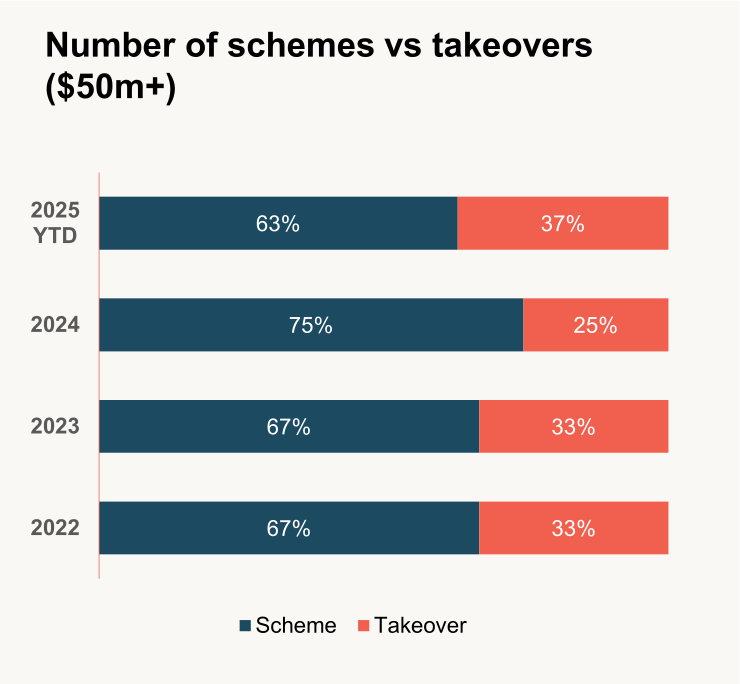
Dig deeper into the figures, however, and it is clear that the takeover bid is far from out of fashion.
Takeover bids represented 37% of all public M&A transactions by number so far, up from 27% in 2024. Takeovers remain in favour for many mid-market transactions, particularly where competing bidders, hostile approaches or shareholder opposition make the 75% scheme approval threshold difficult to achieve. In these circumstances, takeovers still allow for the possibility of securing practical control by acquiring a 50%+ stake through the bid.
This is illustrated by the three transactions so far in 2025 that started out as schemes but ended up proceeding as takeovers:
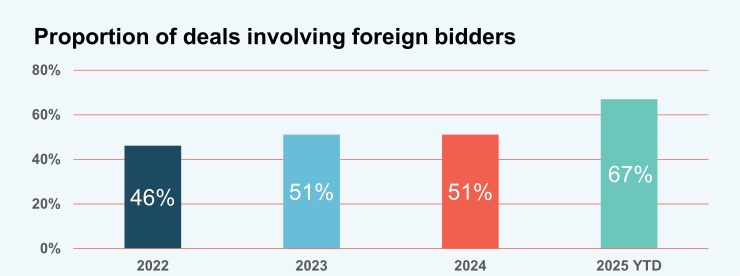
2025 has featured strong public M&A activity by foreign bidders so far, with deals involving foreign bidders comprising 67% of announced deals by number. This is a material increase on public M&A foreign bidder activity seen in 2022 to 2024.
There has not, however, been a proportionate increase in the aggregate value of binding transactions involving foreign bidders. However, in making that statement, it would be remiss of us not to mention ADNOC's, now withdrawn, proposal to acquire Santos which would have single handedly shifted the landscape if it had got to a binding transaction. Nevertheless, with four months remaining in 2025, the announcement of one or two public M&A mega deals involving foreign bidders could significantly change this picture.
Interestingly, nearly two-thirds of announced public M&A deals by number involved bidders from Australia or North America – each of which accounted for 33% of total bids in the year to date. This represents a significant surge of interest from North American bidders, who were behind only 16% of public M&A deals in 2024. This perhaps indicates that US bidders in particular are taking advantage of a continued relatively favourable USD:AUD exchange rate, as we foreshadowed in the introduction to our 2025 M&A Deal Report.
There has also been a more modest uptick in public M&A deals driven by Asian bidders – who were behind 20% of deals announced through to the end of August this year, up from 15% of deals in 2024.
* * * * *
The Ashurst M&A team will be keeping a close eye on all key public M&A trends throughout the remainder of the year. Look out for our full-year wrap up of deal making data in early 2026.
Many thanks to Brandon Lam, Alyssa Croce and Ross Allanson for their outstanding contribution in compiling the key public M&A data and statistics.
The information provided is not intended to be a comprehensive review of all developments in the law and practice, or to cover all aspects of those referred to.
Readers should take legal advice before applying it to specific issues or transactions.


