Progress or plagiarism? The Disney & Universal lawsuit shaping AI and copyright law


Midjourney describes itself as "an independent research lab exploring new mediums of thoughts and expanding powers of the human species". What this apparently means in practice is an AI image generator only available to users with a paid subscription. Those subscriptions allegedly yielded US$300 million in revenue last year.
Disney and Universal say that Midjourney has wilfully infringed their copyright by training its generator to reproduce their works when prompted. They claim that Midjourney's generator is a "virtual vending machine", generating and distributing endless unauthorised copies and derivatives of their iconic characters from franchises such as Star Wars, Marvel, The Simpsons and Shrek. Midjourney's outputs are not only provided to individual users, but also publicly displayed on Midjourney's website to attract and retain subscribers.
In the alternative, Disney and Universal say that Midjourney is secondarily liable for its subscribers' copyright infringement facilitated by the generator. They claim that Midjourney has the ability to control the infringing activity, including by monitoring, blocking and filtering prompts to prevent the generation of copyright-infringing output.
A crucial aspect of Disney and Universal's action is that they allege that the output of the generator infringes, and not just the fact of the model having been trained using their works. This contrasts with one recently decided case in the USA (the Claude case), in which the training of the AI "Claude" using literary works was found to be a transformative use falling within the USA's fair use defence. However, Claude's operator had implemented measures to prevent the model outputting copyright-infringing works, and the plaintiff did not claim that Claude's output itself infringed.
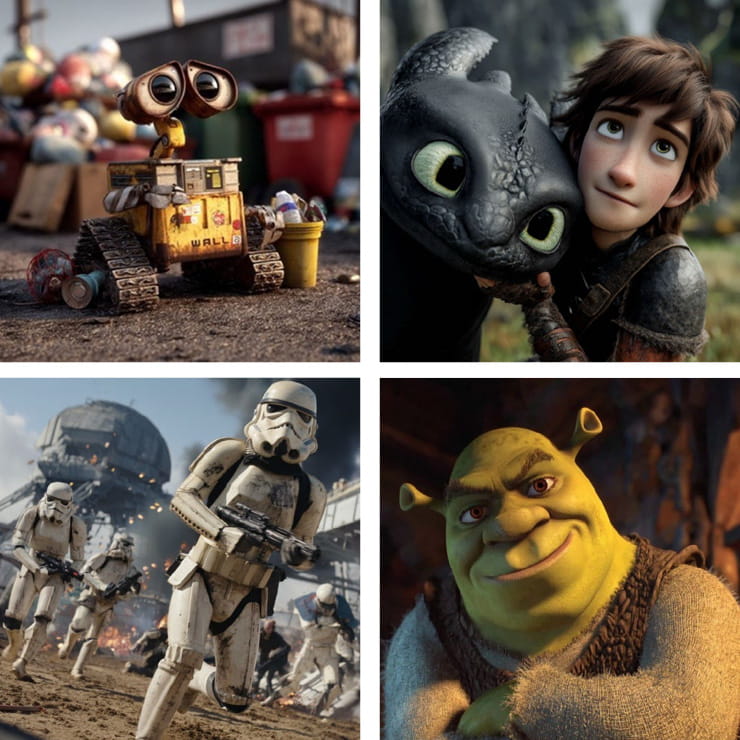
It's not hard to see why Disney and Universal have taken their position, having regard to the examples of allegedly infringing outputs cited in the claim.
Those include the following Midjourney-generated images:
Midjourney's response
Midjourney has rejected the allegations, saying amongst other things that:
In Claude, the court reasoned that the AI was not intended to "race ahead and replicate or supplant" the works on which it was trained. Instead, it created altogether different texts that were inspired by those works, like any human author can be inspired by the books they have read. The court had regard to particular software deployed within Claude to prevent the generation of infringing content.
In the present case, it appears from the pleadings that Midjourney has not taken the same steps to restrict the output generated by its model. Indeed, Midjourney seems to claim that it should not be required to do so.
Midjourney likens its image generation to the creation of fan art, in the pursuit of experimentation and ideation. It claims that Disney and Universal seek to "stifle" legitimate uses of copyright works.
Of course, Midjourney conveniently ignores the raft of (uncontroversial) cases around the world in which human creators of fan art have been restrained from commercially benefitting from that art in online marketplaces such as Etsy and Redbubble. It is one thing to produce something, and another to sell it.
It is plain that if a person offered to create and sell an artwork comprising any of the exemplar images above, they would be engaging in unlawful copyright infringement. Disney and Universal's rights in respect of their characters extend to any derivative works in which a "substantial part" of a character is reproduced.
It is solely Disney and Universal's right to offer to make and sell artworks displaying their characters, or license another to do so. It would be no answer to say that the appearance of "Shrek" folding his arms and having a particular expression is valid "experimentation" or "ideation".
There are those who consider that the traditional principles of copyright law will be adequate to assess cases involving AI. This case would seem to be an ideal example in favour of that proposition. Given how perfectly and quickly Midjourney reproduces the original works with no real effort by a subscriber, Midjourney's generator can hardly be compared to a pen or a paintbrush.
Further, it seems entirely possible for Midjourney to implement measures to prevent infringing output, as has been done by many (if not all) of the mainstream AI generators, including Claude and ChatGPT.
As for Midjourney's argument that Disney and Universal themselves use generative AI, it is unclear how that changes anything. There's no suggestion that they are using AI to copy other creators' characters or works (if a 'hypocrisy' argument is even a defence to infringement in the first place).
Midjourney likely faces an uphill battle to defend its position on whether its output infringes copyright. It's likely that Midjourney will ultimately be required to at least adopt the kind of content controls that are now standard in the industry.
The question remains as to whether the training of Midjourney's model on Disney and Universal's works is also infringing, and whether the court will adopt the reasoning in Claude in that respect.
There is no general "fair use" defence for copyright infringement in Australia. The comparable Australian defence is "fair dealing", which applies when the work is used for specific and narrow purposes such as research, study, criticism, review, parody or satire.
Australia's fair dealing defence is much narrower than the fair use defence in the USA. It's possible that a case involving the use of copyright works to train an AI model for profit in Australia could lead to a different result than in Claude.
The Australian legislature has not proposed steps to reform copyright law in response to the advent of AI. However, the Productivity Commission recently published an interim report titled "Harnessing data and digital technology", identifying prospective areas for reform.
The report suggests the introduction of a new category of fair dealing covering AI models, rather than introducing a new "fair use" regime akin to the USA's. While the report says that this new category could specifically cover AI model training, it does not propose extending the exception to infringing output.
In the meantime, owners of Australian copyright can take some comfort that traditional principles of copyright law will continue to apply and any AI generated outputs that reproduce their works will still likely be prohibited.
Other author: Elise Jensen, Lawyer.
The information provided is not intended to be a comprehensive review of all developments in the law and practice, or to cover all aspects of those referred to.
Readers should take legal advice before applying it to specific issues or transactions.


